Service opens on a recent fall day at Community Kitchen, a pilot restaurant launched by Mark Bittman, Rae Gomes and Mavis-Jay Sanders. (Miranda Lipton)
For the first time in his life, a New Yorker in his late 70s was able to take his entire family out to dinner.
On September 19, on a quiet, tree-lined street on Manhattan’s Lower East Side, he and his family joined 60 others at Community Kitchen, a sliding-scale fine dining nonprofit restaurant, launched by former New York Times columnist and food justice advocate Mark Bittman.
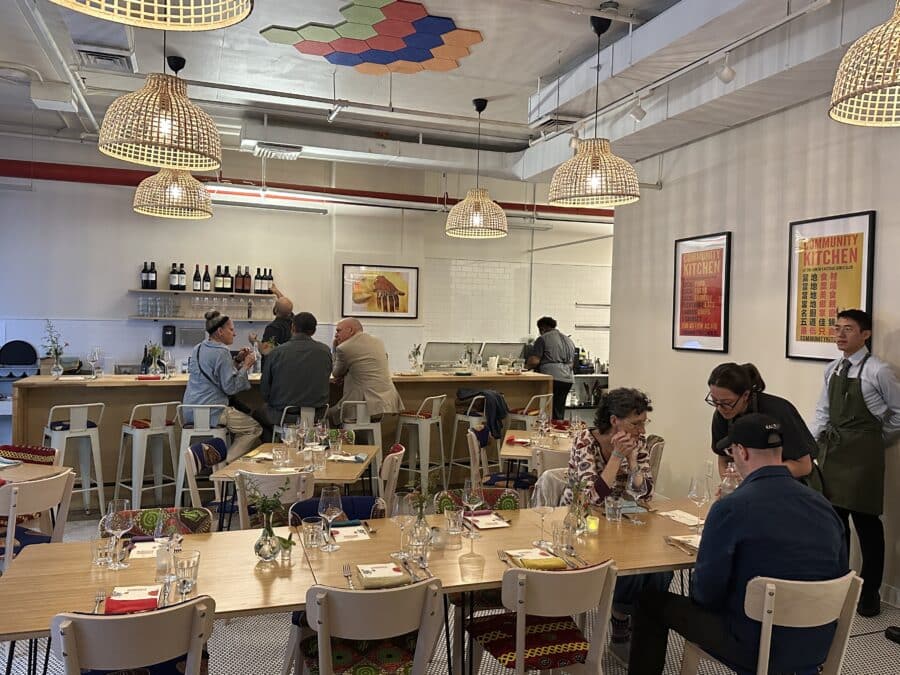
Service opens on a recent fall day at Community Kitchen, a pilot restaurant launched by Mark Bittman, Rae Gomes and Mavis-Jay Sanders. (Miranda Lipton)
The restaurant’s two-month pilot, housed in the Lower Eastside Girls Club, aims to welcome guests from varying economic means to experience artfully prepared meals at a price they can afford, sourced directly from farmers in the region. In doing so, the Community Kitchen team aims to build a model founded on the belief that healthy, delicious food should be accessible to all, and that it doesn’t need to come at the cost of fair labor or environmental compromises—–from the farmer tending the soil, to the hostess welcoming guests, to the diner from the local neighborhood.
The chance for folks of all income levels to gather in one place and eat high-quality food, such as the local man who brought his family to the restaurant, is “a big deal,” says Community Kitchen Culinary Director, Chef Mavis-Jay Sanders, who won a 2022 James Beard Leadership Award as the director of culinary development at the Philadelphia-based nonprofit Drive Change.
“To help give somebody that sense of pride—that they can take care of and feed their family well. To offer a space where people can have celebratory moments where they’re held and taken care of in community,” is a reward unto itself Sanders says.
Mavis-Jay Sanders with Mark Bittman in the Community Kitchen. (Courtesy of Community Kitchen)
After about four years and nearly $2 million in fundraising, Bittman launched the nonprofit restaurant alongside Rae Gomes, Community Kitchen’s executive director. Their hope, he says, is “to turn the food system on its head.” The move followed a decades-long career in food journalism and a desire to bring its impact to life by sharing food in his local community. Bittman grew up just blocks from where the restaurant is based.
Guests have three price tiers to choose from: $15, $45 or $125. Community Kitchen’s website states that $45 covers the full cost of the meal, while $125 “helps sustain our mission.” Community Kitchen aims to have about half of their reservations saved for diners who can pay $15, with the other half split between the middle and higher tiers. Reservations can be made online, creating the opportunity to select your price-point anonymously. Regardless of what guests pay, every diner receives the same multi-course, farm-to-table meal.
The table and menu is set and open for service at Community Kitchen. (Miranda Lipton)
The restaurant’s financial model runs counter to how for-profit restaurants operate, which the team hopes can serve as a catalyst for systemic change.
“Look, if you wanna make money in restaurants, especially in New York where the rents are so high … where are you cutting corners?” says Bittman. “Either you’re understaffed, you’re underpaying—or both. Or you’re cutting corners on your sourcing. Or you’re just really expensive. All our people are being paid well. And it’s because we’re losing money.”
And with a James Beard Award-Winning chef leading the kitchen, taste is never in question.
Community Kitchen is a part of a small but growing global public restaurant movement. There are some examples of government-funded restaurants internationally that provide income-dependent pricing structures for meals. Bittman points to The Popular Restaurant initiative in Belo Horizonte, Brazil, as the best example of subsidized healthy dining in the world.
“Anyone that’s done a lot of food system work, I think, comes to the realization that because of the way our food system is set up, you cannot do anything value-centered that is not subsidized,” says Gomes.
Funding for the pilot, and for the following year, comes from Bloomberg Philanthropies, Grace Foundation, Kapor Foundation and Ford Philanthropy, among others.
Beyond that, Bittman says that success looks like “raising enough money to exist as the core small nonprofit, which is only four or five people, through 2026 with plans for ‘permanent,’ with air quotes around it, restaurant in 2027.”
He imagines the restaurant will continue to need external support, should it become a permanent operation.
“Bear in mind that industrial agriculture and everything it stands for, which includes fast food, factory farming and so on, wouldn’t be profitable without government support. It’s just supporting a destructive form of agriculture and diet.”
Example dishes prepared at Community Kitchen. (Courtesy of Community Kitchen)
Community Kitchen’s advisory board includes Alice Waters, chef José Andrés, author and food system advocate Marion Nestle, One Fair Wage founder Saru Jayaraman, farmer organizer and food justice advocate Karen Washington and Rep. Jim McGovern (D-Mass.-02).
With this support, the team can explore how an operation not constrained by the pressure to survive can be equitable from literally the ground up.
The minimum wage in the restaurant is $32 an hour, plus tips. Food is sourced directly from local farms or through distributors that themselves work with farmers. The goal is to eventually build all relationships directly, but the pilot’s short timeline made that difficult for this season. The restaurant also composts all food waste through the city’s municipal food waste program.
Those tight-knit farm-to-restaurant partnerships could provide farmers with stability—allowing them to dedicate part of their harvests or even cultivate unique crops specifically for the restaurant. For diners, that would bring in new flavors or more nutrient-dense produce.
Getting nutrient-dense foods into the hands of those who need them most is a driving force for Sanders and the team.
“I want to focus on people who don’t have access,” Sanders says. “If there’s a new food being introduced to an area, I want it to be available to the people who need it most. If we’re breeding vegetables that are nutrient dense, the people who lack the most nutrients should have access first.”
Given the economic fragility of small and independent farms, these partnerships can help sustain farmers—and the rural communities where they live—through climate, policy or market changes.
Although Community Kitchen is still in early stages of developing farm partnerships, they are already seeing signs of reciprocity.
Ashanti Williams, a black farmer in upstate New York, typically sells her produce locally. When she found herself with a surplus of shishito peppers, Sanders was able to adjust the restaurant’s seasonal menu to include them, both supporting Williams and preventing the waste of perfectly good produce.
Williams’s parents drove halfway down to Manhattan, and Sanders drove halfway up to Argyle, New York, to exchange the produce.
“If her parents can come down and meet me halfway, then let’s take the extra time,” says Sanders. “Let’s do the extra lean, the extra reach, to grab your neighbor’s hand.”
Community Kitchen prioritizes sourcing from Black, indigenous and other farmers from background that have long faced systemic barriers to land and financial resources. Black farmers today make up barely 1% of U.S. farmers, despite making up over 12% of the population.
The team behind Community Kitchen. Standing, Albert Nguyen, assistant GM, Andre Gennitti, general manager, Mark Bittman, chef Mavis-Jay Sanders, executive director Rae Gomes, David DeVaughan, senior advisor. (Courtesy of Community Kitchen)
When Williams and her wife later drove two hours downstate to dine at the restaurant, Sanders felt the significance.
“The fact that somebody would travel two hours to eat with us when they’ve got kids, when farming is already so labor-intensive,” she says. “It’s an honor that somebody would want to spend their time and money here, and then to be blown away and feel taken care of. That’s a big thing.”
The team hopes Community Kitchen can serve as a blueprint that spawns similarly impactful ventures across the country. After the pilot, there are thoughts of building a permanent restaurant or developing a consulting network to support other restaurants ready to join the movement.
“We have a strong interest in being in other communities,” says Gomes. “Whether we’re supporting directly or indirectly, there needs to be a robust, community-based process restaurant to decide what type of restaurant belongs there.”
No matter the form it takes, one thing is clear: the team’s dedication to an accessible, equitable and dignified food system is unwavering. “Removing profit from the center is very antithetical to how food is in America,” says Gomes. “But Mark utilizes his privilege to bring in money to support this project, which puts us in a position to try things, center our values and not worry about being paid.”
Miranda is a food journalist based in Brooklyn, New York. She is a 2025 fellow in the John’s Hopkins Food Systems and Public Health Journalism program, and her work can be found in Mother Jones, The Guardian, National Geographic and more.
Have thoughts or reactions to this or any other piece that you’d like to share? Send us a note with the Letter to the Editor form.