
I was 23 in January 1956 when I stepped off the Cunard liner Britannic on American soil for the first time. I had worked hard to save the £68 for the six-day journey from England. I was met in downtown New York by Karl Miller, my Scottish boyfriend, who was already in America studying for a Ph.D. He drove me in the rusty hump of a Buick he’d been given by an old university friend, first to Staten Island, where we had other friends, and then along the Merritt Parkway to Cambridge, Massachusetts, where Karl had found us a flat on Hawthorn Street.
What Has Happened to the America I Remember?
At least we in Europe have one thing to thank Trump for
Jane Miller
February 16, 2026
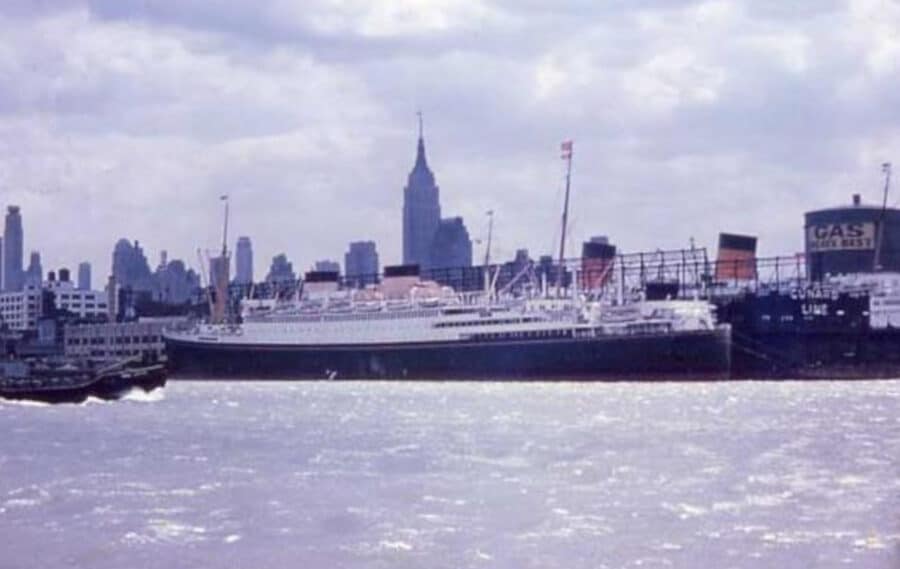
The Britannic, at one time the "largest motor ship in the world," at dock in New York City in 1959.
The Britannic, at one time the "largest motor ship in the world," at dock in New York City in 1959.
There Karl introduced me to the youngish landlord called Durham Miller. The day after my arrival Durham knocked on our door and said that he didn’t like having sinners in his house, and we should get married. So we did, a week later.
What I’m trying to remember now is what I knew or imagined about your vast country before I ever set foot in New York. “My” America, the one I knew, had been mostly small town or rural. I hardly knew about the big cities, the skyscrapers or Wall Street. I was never good at geography. Though I watched with awe Westerns like Duel in the Sun and wallowed in the hot Southern romance of Gone with the Wind, I’m not sure how well I understood the absolute differences between those parts of America.
I’d heard of the painted desert and the Grand Canyon, and I’d watched a world of sheriffs and posses and feathered Indians and cattle droving, without quite understanding what was happening or why it was so different from farming in the British Isles. I knew a bit about California from John Steinbeck and about poverty and slavery from Mark Twain and Huckleberry Finn. I must have read my first novels by Henry James before I arrived in the country whose inhabitants he wrote about, though it was the country he more or less left behind in favour of mine.
I remember Pearl Harbour, but not much about what people felt about America joining the war. I was only 9 in 1941. But I think I remember a bewildered sort of relief. My first real Americans were soldiers, black and white soldiers, sitting in a line of tanks and trucks moving slowly north from the port of Portsmouth through the small Hampshire town Petersfield where I lived . I was about 13. They showered us with packets of chewing gum. That must have been towards the end of the war.
When I was 15, I played the grown-up Emily in a school production of Thornton Wilder’s Our Town, while a younger girl played Emily’s teen-age self. I don’t think either of us tried to speak with an American accent. But well before all that I had read again and again all four Little Women novels by Louisa May Alcott and sided, as I was surely meant to, with Jo. Tomboys were popular heroines in those days, long before feminists. Simone de Beauvoir wrote with passion about the inspiration and encouragement Alcott’s Jo had given her as a girl.
In 1956, my new husband and I were to travel with two friends round the country. We drove south to New Orleans and then through Galveston, Texas, to Los Angeles and finally San Francisco. Our Buick broke down in the end, and we flew (it was my first time ever) to Chicago and then to New York. But we missed the Kansas home of another early favourite of mine, Laura Ingalls Wilder and her Little House on the Prairie.
And there was jazz. In the late 1940s, I went to the jazz club at No.100, Oxford Street, in London, where Humphrey Lyttleton and his band played once a week. I think this was the beginning of British Jazz. Lyttleton got his imprimatur from Louis Armstrong, who famously described him as “that cat in England who swings his ass off.” I soon learned that real jazz was American, and Black, as were the blues. Indeed, the folk-singing friends who accompanied us on our travels in 1956, visited the club where their hero, Leadbelly, had once played.

So “my” America really begins in 1956, the year when Eisenhower was elected for his second-term as president, defeating Adlai Stevenson for a second time, disappointing Karl and me, and a large minority of Americans.
Two years earlier, Americans had undergone the McCarthy hearings. Some people we knew were ex-Communists, and quite a lot of our friends were gay. We were told not to talk about that. The geography department at Harvard, the American university we were now part of, had recently been disbanded because of homosexuality. Coming from Cambridge University, where talk about politics and sex was a good deal easier, we were surprised; though homosexuality was illegal in the U.K. until 1967.
Neither the United State nor the United Kingdom. were innocent of intolerance, racism or gross inequality. However, since then, everything about America—its politics, its art, its films, its literature, and a good many of its inhabitants—have interested me, more than those of any other country but my own. Of course, the common language helped.
But what about now?
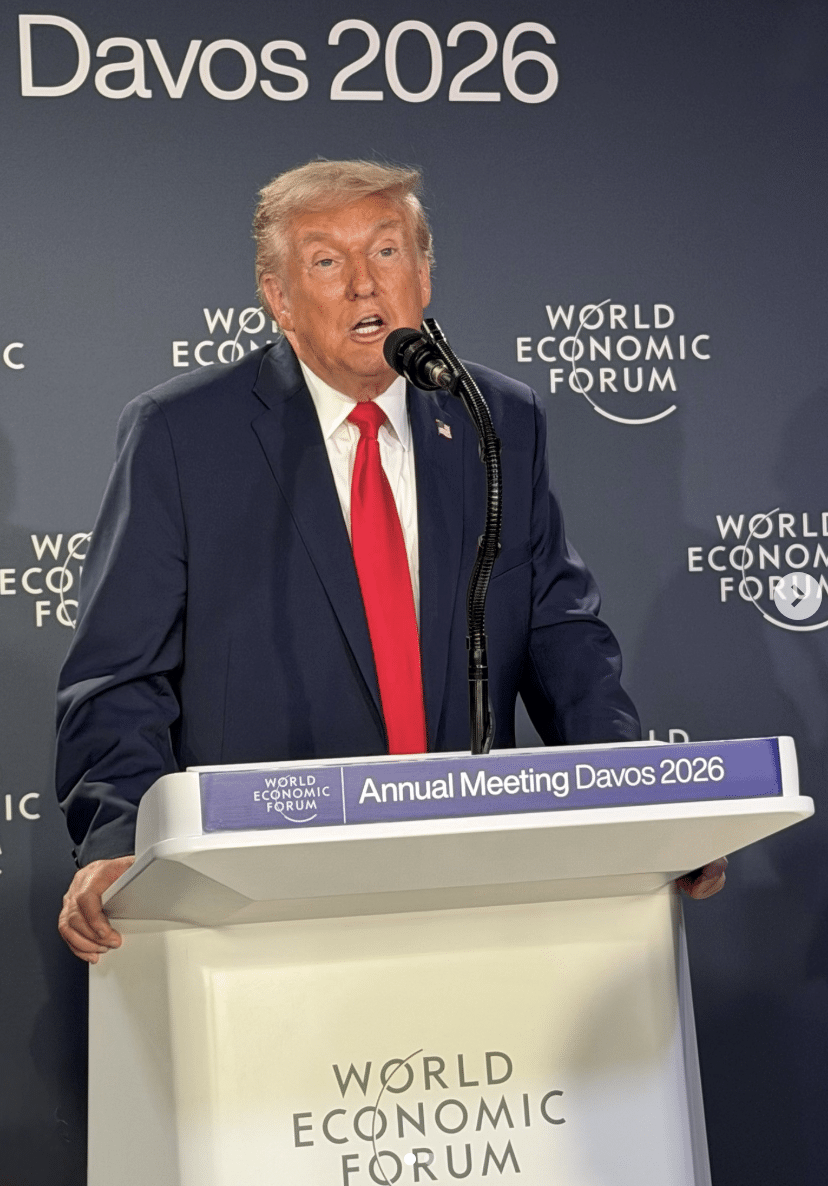
At the World Economic Forum in January, President Donald Trump spoke for more than an hour about what’s wrong with the world, including that Europe apparently has too many people who are not white: “Certain places in Europe are not even recognizable, frankly, anymore, they’re not recognizable. … Friends come back from different places–I don’t want to insult anybody–and say, ‘I don’t recognize it,’ and that’s not in a positive way.“
The particular brand of presidential dishonesty and lawlessness pervading your country has had its devastating effect on this country too. Or, should I put it differently? A new carelessness and intolerance has invaded many so-called Western countries. In Europe, this has meant waking up to our dependence on America, and to our surprised and belated realisation that no individual European country has the slightest hope of standing up to what are now the “great powers”—whether China, Russia or the United States—on its own.
The U.K. clings to its dream of “a special relationship” with the United States, more than ever since Brexit, when in 2016 the UK foolishly voted to leave the European Union
Nor can it quite forget the days when the sun never set on its empire. So, there is a special irony—rather than a special relationship—in the fact that the Jeffrey Epstein scandal has hit the British royal family (Prince Andrew, which is what Americans call him, is no longer a prince and is referred to here as Mr. Andrew Mountbatten-Windsor, which is almost as ridiculous) and undermined our prime minister (Keir Starmer) well before it has turned on your president. Our prime minister has not been doing well after appointing the deceitful Lord Peter Mandelson to be our ambassador in Washington (appointed in February 2025, dismissed in September 2025 over his ties to Epstein). Yet Starmer must be one of the few powerful men in the world, who have not cosied up to Jeffrey Epstein.
Trump’s re-election has brought pain and disbelief that Americans could vote for someone so unreliable, untrustworthy, dangerous. Here he is thought of as possibly insane, occasionally (and accidentally) right, as in telling Europe to look after itself. Nonetheless he is a serious threat to peace, health, the climate, moves towards greater equality, and so on.
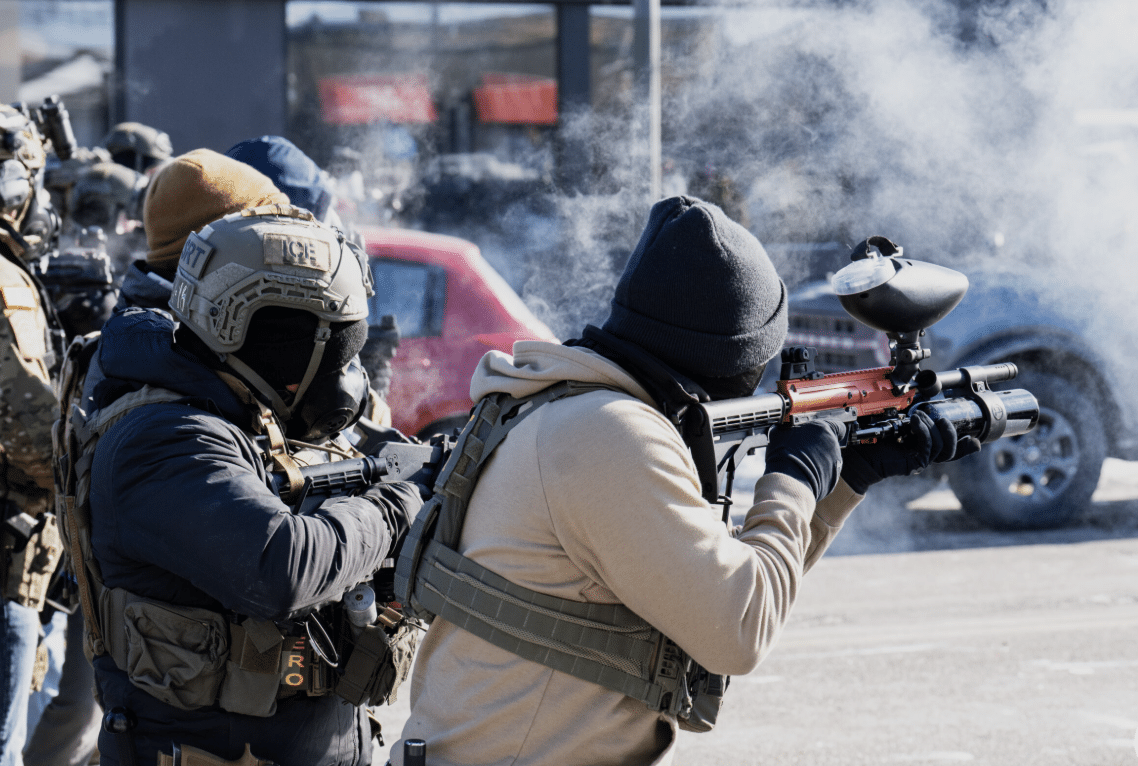
The videos we’ve been watching of masked men in combat gear terrorizing, and even killing, the people of Minneapolis have been heart-breaking. I think a majority of Brits are appalled and frightened by what’s happening in America. Those images are as shocking as the terrors Trump’s foreign capers are creating in other countries.
Has he any idea of the lives lived by people in other parts of the world? Does he know the difference between Greenland and Iceland? Does he ever listen to what other people tell him if they’re not in his “gang”?
When Trump lambasted Zelensky in February last year in the oval office, he seemed genuinely to believe that naughty little Ukraine had threatened Russia. We still wonder whether he can write anything apart from his name.
And we laugh when Trump and Vice President J.D. Vance tell us in Britain—along with our European neighbours—that we are finished as a civilisation, an irrelevant “has been,” no longer powerful or independent; no good at trade, and barely in control of our borders. But it’s a painful laugh, unsure of itself.
It isn’t all darkness. Trump has made it clear for a majority of Brits that our place is in Europe, and that it is possible to overturn Brexit.

Jane Miller writes the "From the Old Country" column for Barn Raiser. Born in 1932, Miller lives in London. She is the author of the critically acclaimed Crazy Age: Thoughts on Being Old (Virago) and most recently In My Own Time: Thoughts and Afterthoughts (Virago), a collection of her "From the Old Country" columns published in In These Times. Miller, a graduate of Cambridge University, first worked in publishing, then as an English teacher in a London comprehensive school and finally as a professor at the London University Institute of Education.
Have thoughts or reactions to this or any other piece that you’d like to share? Send us a note with the Letter to the Editor form.
Want to republish this story? Check out our guide.


More from Barn Raiser

Read →
Union Smokejumper Faces MAGA Radio Host to Replace Zinke
Grizzly bears, timber and dead livestock could sway western Montana race