






For generations, America’s farm policy has claimed to support a simple premise: when family farmers succeed, our country succeeds. The farm bill, originally passed as the Agricultural Adjustment Act of 1933, was created to stabilize markets during the Dust Bowl and the Great Depression, ensuring that agriculture remained a viable livelihood for those willing to do the hard, consequential work of feeding a nation. More than 90 years later, the farm bill has undergone fundamental changes—but it remains our largest opportunity for collective investment in the future of young and emerging farmers, as well as the structural reforms that support conservation and access to land.
The Senate Must Pass a Farm Bill That Serves Young and Beginning Farmers
Senate leaders must invest in the next generation of farmers
Michelle A.T. Hughes
June 22, 2026
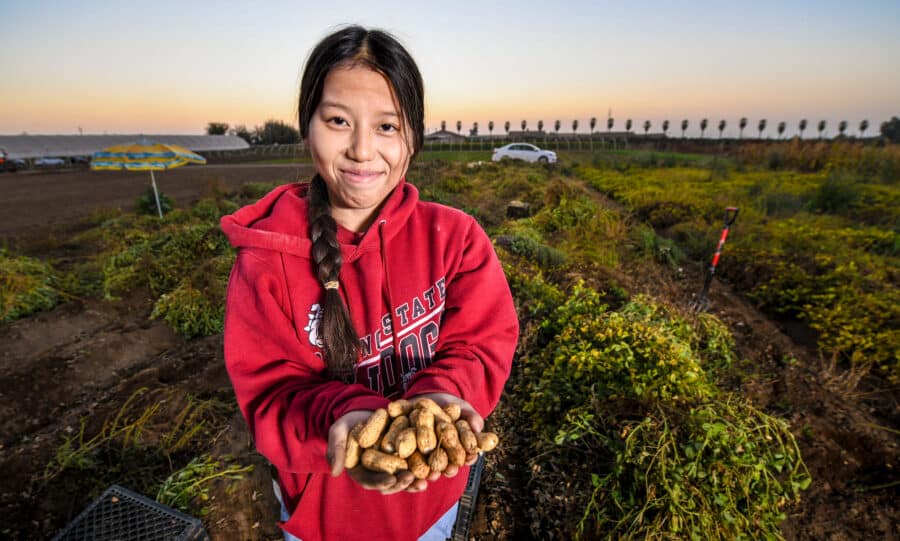
Mai Houa Yang is a Hmong farmer who grows specialty crops, such as the peanuts she holds in her hand, on a 10-acre family farm in Sanger, California, near Fresno, on November 9, 2018. She and her husband, Vue Her, run VH produce, which previously worked with the U.S. Department of Agriculture (USDA) Natural Resource Conservation Service (NRCS) to implement many conservation improvements, including help replacing an old tractor for a more efficient lower emission tractor and installation of seasonal high tunnels. (Lance Cheung, USDA)
Mai Houa Yang is a Hmong farmer who grows specialty crops, such as the peanuts she holds in her hand, on a 10-acre family farm in Sanger, California, near Fresno, on November 9, 2018. She and her husband, Vue Her, run VH produce, which previously worked with the U.S. Department of Agriculture (USDA) Natural Resource Conservation Service (NRCS) to implement many conservation improvements, including help replacing an old tractor for a more efficient lower emission tractor and installation of seasonal high tunnels. (Lance Cheung, USDA)
Today, too many young and emerging farmers face extreme distrust of Congress, questioning whether our country’s lawmakers will choose to break free from the corporate monopolization and industrialized farming system. We have entered new territory after the passage of H.R. 1 (One Big Beautiful Bill Act) last year. The bill bypassed the traditional bipartisan farm bill process to inject $59 billion to support commodity “safety net” programs in Title I and Title XI of the farm bill. These legislative investments in programs for large-scale monoculture farmers have left the path open for a “skinny farm bill,” one that fails to unite nutrition programs and farmer advocates, and to serve all of American agriculture.
On April 30, the House of Representatives passed their version of the farm bill, The Farm, Food, and National Security Act of 2026 (H.R. 7567), in the first floor vote on the farm bill in eight years. The last farm bill (typically negotiated in five-year cycles) was passed in 2018, and debates over the current farm bill have been deadlocked since 2023. The House bill upholds the traditional 12 titles of previous farm bills. According to the Congressional Budget Office, the bill would be budget neutral over 11 years. But that’s only because lawmakers funded the most expensive programs in last year’s reconciliation package. The House bill accepts the $187 billion in cuts to food assistance programs like the Supplemental Nutrition Assistance Program (SNAP) in H.R. 1, as well as the $66 billion in subsidy spending toward the largest commodity operations. And it calls this progress. The farm bill should not be used to concentrate power, suppress opportunity, or drive folks further into poverty.
Today, we await the Senate’s draft of the farm bill. We are urging the Senate to prioritize the success of new farmers and ranchers. [Update: On June 23, the Senate Agriculture Committee released its draft farm bill text. You can read it here.]
The National Young Farmers Coalition exists to shift power and change policy to resource the new generation of working farmers. For nearly 15 years, we have been advocating for federal farm policy that supports land access, conservation practices, farmer mental health, and business development. We represent over 200,000 young farmers, ranchers, and advocates across the country. According to our last national survey, the majority are first-generation farmers, are highly educated, run diversified operations, 63.5% are female or nonbinary, and 86% identify their practices as regenerative. It is essential that our legislative representatives give producers a voice in the policies that shape their daily lives.
We hear directly from new producers across the country—people raising vegetables, fruits, meat, flowers, beans, and honey for their communities. These are the same farmers Congress claims it wants to cultivate: innovative, conservation-minded, rooted in place, and determined to build businesses that can survive for generations. Yet many young farmers and ranchers spend as much time navigating barriers to farming as they do farming.
Farmland prices are out of reach, and land is increasingly cash-purchased by corporate investors and speculative buyers. Those transactions close in days, while FSA farm ownership loans take months to approve. The House bill fails to address this consolidation, choosing instead to focus narrowly on foreign ownership while the larger structural crisis goes unaddressed.
On top of a lack of affordable farmland, input costs are crushing farmers. Farm consolidation continues unabated, with the U.S. losing 15,000 farms in 2025 and the average farm size increasing. And U.S. Department of Agriculture (USDA) programs routinely fail to reflect the realities of small and diversified operations, or are canceled without warning or recourse. In March, for instance, the USDA issued termination notices for 49 of 50 Increasing Land, Capital, and Market Access (ILCMA) projects. These were innovative, community-based projects designed to tackle the affordability barrier facing young, beginning, and underserved farmers. Elimination of this one program alone leaves farmers with a $300 million hole that the federal government had promised to pay.
Every year, farmers question whether they can keep going.
Our current policy architecture rewards scale above all. Instead of empowering the rising generation of producers, it reinforces an agricultural economy where only the largest operations can survive. We meet a steadily increasing number of young farmers with land priced beyond their means, programs won’t quite fit or will only provide marginal benefit, and support systems aren’t designed with them in mind. This is not an accidental flaw; it is a choice Congress has made for the next generation of working farmers.
The consequences of these flawed choices affect our agricultural industry and extend well beyond the farm gate. When we systematically push independent farmers and ranchers out of agriculture, we hollow out rural communities, narrow economic mobility, and create a system where fewer corporations hold more power over what is produced, how it is grown or raised, and who profits from it. That is not resilience; that is a fragile monopoly.
We have to stop pricing young farmers out of agriculture before they ever get a fair start. Farmers are the experts in soil health, risk management, and local food economies that will shape a resilient future for food and farming. Young farmers use innovative business models to produce food and lead in a world that is changing faster than our federal policy. At a moment when agriculture could be a meaningful part of our response to climate disruption, food insecurity, and economic decline, ignoring this generation is not just a missed opportunity, it’s a leadership failure.
The Senate has an opportunity and a responsibility to do better. Senate farm bill text is expected this week from the Senate Agriculture Committee, chaired by John Boozman (R-Ark.), with a committee vote later this summer. It will be another five to seven years before we get a chance to meaningfully revisit these policies.
We’ve known for decades that we need a farm bill that expands access to land and capital. We need programs that fit the scale and diversity of modern farming operations of all sizes. We need programs at the USDA Natural Resources Conservation Service that help small farmers adapt to severe weather, like droughts, floods, and frosts. We need a continued mental health infrastructure for rural farmers and communities under financial distress. We need young farmers to be recognized as the rising and established leaders we are. And we need lawmakers who understand that their legacy will one day be measured by whether the next generation of farmers can actually build a future for our country’s agriculture system.
The Senate must pass a farm bill that invests in what agriculture is becoming, not what it once was. Show up for young farmers before our window closes. The future of food and farming in this country depends on whether or not we choose to make room for the people ready to grow it.

Michelle is from New Haven, Connecticut, and was a hog farmer at the University of Pennsylvania. As Executive Director of the National Young Farmers Coalition, she provides strategic direction and oversight to advance the organization’s mission: shift power and change policy for the new generation of working farmers. From 2022-2025, Michelle served on the U.S. Department of Agriculture’s Equity Commission, where she co-authored a landmark report offering 66 recommendations to address USDA’s legacy of discrimination. She brings a collaborative, movement-oriented approach to her work, centering farmer voices, frontline communities, and the belief that lasting change requires both grassroots leadership and institutional transformation. Michelle is a graduate of Haverford College and earned her M.A. in Food Studies from New York University. She is dedicated to advancing equity in agriculture by bridging the lived experiences of farmers with systems-level policy reform.
Have thoughts or reactions to this or any other piece that you’d like to share? Send us a note with the Letter to the Editor form.
Want to republish this story? Check out our guide.


More from Barn Raiser

Read →
Can We Feed the World Without Frying the Planet?
Real Organic conference explores contrasting approaches to feeding 10 billion people

Read →
‘Win, Lose or Draw,’ Pearson Campaign Builds a Progressive Coalition in Rural Tennessee
GOP gerrymander faces blowback amid data center opposition and economic discontent