






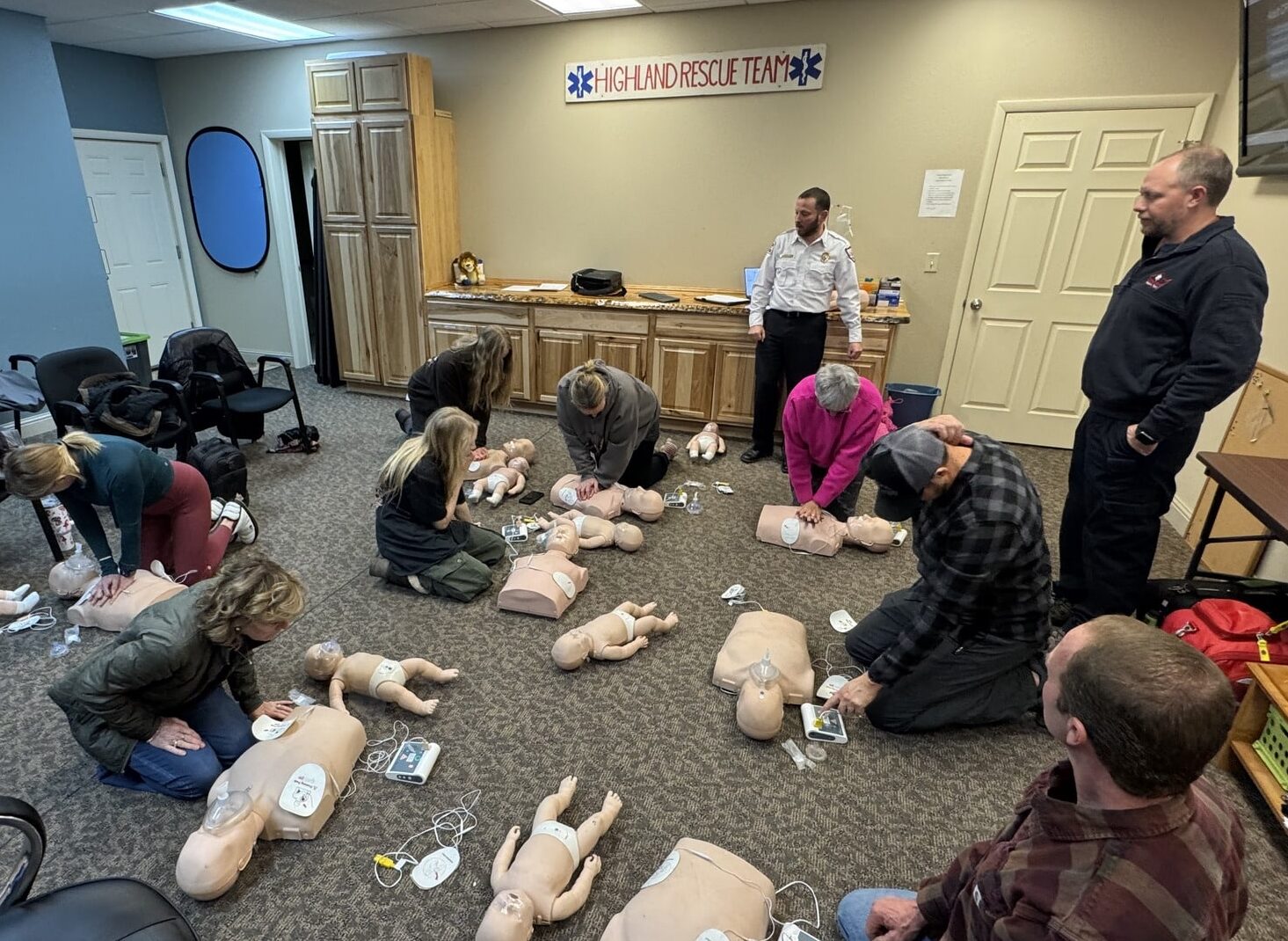
In September, Jasmine Burke, a paramedic with the Highland Rescue Team Ambulance District in Colorado, responded to a 911 call for someone with suicidal thoughts. That is all that anyone can know about the case, she says, ultimately leaving the patient with back-up. But the call itself represents a growing trend in rural areas where behavioral health emergencies have strained the capacity of local emergency services.
Better Rural Mental Health Care Is Under Our Nose. Why Can’t More Communities Use It?
In rural areas, a dependence on volunteer labor has created vulnerable local emergency response systems
Karen Fischer
October 20, 2025

In rural areas, it has become common for emergency medical service providers to respond to behavioral health issues. But such services are not equipped to provide the kind of long-term care needed for behavioral health. (Erik Marquez)
In rural areas, it has become common for emergency medical service providers to respond to behavioral health issues. But such services are not equipped to provide the kind of long-term care needed for behavioral health. (Erik Marquez)
“We get calls like this all of the time with psychiatric emergencies, suicidal ideation and intoxication,” she says.
In rural areas, such calls have become more common over the years, Burke says. Consequently, all responding emergency medical service (EMS) workers follow a stringent procedure prior to arriving on scene. That includes gathering information on the patient, such as their gender, age, and if they have someone else in the house with them. En route the team also brainstorms on what they may be walking into with the information they do have at hand. EMS workers like Burke also follow protocol to assess the situation in-person and determine if the person experiencing the mental health emergency can be talked down from building rapport, or if they need a medical intervention.
The Highland Rescue Team Ambulance District was created by a special districting law in Colorado that allows local governments to create systems that fill the gap in services provided by counties or municipal governments. The Highland rescue team covers 33.5 square miles in the Colorado foothills west of Denver off of I-70. About half of Burke’s calls are in the city, and the other half are off-the-grid, rural homes and hiking trails in Jefferson County and Denver Mountain Parks.
Why isn’t there more money to go around for [community integrated health care systems], and how could they help rural communities be healthier?
But Burke says that one limitation of EMS service is that it’s not designed to continually follow-up with the patient and make sure they’re alright in the long-term.
“We respond to people in crisis on their worst days, but we’re not equipped [to provide] long-term management.”
One way to fill this long-term gap is through community integrated health care systems (CIHCS), which provide home health care services for non-emergency situations. Colorado first adopted CIHCS in 2017, allowing both emergency medical technicians (EMTs), paramedics, nurses, nurse aides and social workers to go into the field and respond to calls to treat in place within their scope of practice, as well as provide scheduled preventative and follow-up care that may be requested by a physician. In Colorado nearly 10,000 people have received CIHCS services in the past five years, which has correlated to a 71% decrease in non-urgent ER visits. They are present in some form in over 40 states.
The approach is gaining legal steam in Congress. In June, U.S. Reps. Emanuel Cleaver, II (D-Mo.-05) and Diana Harshbarger (R-Tenn.-01) introduced H.R.4011, the Community Paramedicine Act of 2025. The bill would expand grant access and fund state-based CIHCS programs, a move that would ultimately reallocate spending, but not increase the overall budget for rural health care. The bill is currently in committee. It’s certainly a start, but when one looks at the cost to individuals, hospitals and health systems to take someone to the ER when they could receive an intervention at home, the financial gulf is vast.
This is exacerbated by the One Big Beautiful Bill (OBBB) passed on July 4, which will put enormous strain on both rural hospitals and communities. According to the nonpartisan Congressional Budget Office, the bill will cut $911 billion in federal Medicaid spending over the next decade, resulting in an estimated 10.3 million people losing their Medicaid health insurance. At the same time, rural areas are expected to lose $137 billion in federal Medicaid spending over the next decade, a figure hardly equaled by the addition of a $50 billion “rural health transformation program” in the bill. These cuts will have major downstream implications for rural mental health, as Medicaid is the single largest funder of behavioral health services in the United States, paying for roughly a quarter of all mental health and substance use disorder treatment.
Why isn’t there more money to go around for these CIHCS services, and how could they help rural communities be healthier?
Mental health capabilities
From a mental health perspective, CIHCS agencies can provide a range of essential services: education, referrals to medical providers, conducting mental health screenings, keeping in contact with patients in addiction recovery, responding to a mental health crisis and dispensing medication. The catch is funding.
One of the massive financial hurdles for CIHCS programs is that they are part of EMS infrastructure that has been chronically underfunded for decades.
Lisa Ward, an EMS industry lobbyist for Frontline Public Affairs and emergency medical technician in Denver, says that no matter where one is in the country, an ambulance is not reimbursed for services if it does not bring a patient to a hospital.
“We operate in a state of readiness, but if we don’t transport you, if we treat you in place and put a bandage on your cut, we do not get paid for that,” she says.
Only 21 states designate EMS as an essential service, which puts it on par financially with firefighters or police. With that designation, states can allocate a funding source towards EMS agencies, such as a tax. But without that designation, there is no requirement for states to fund EMS systems or CIHCS programs. This means that in most rural communities, EMS providers are volunteers, Ward says, and unpaid for their work.
In rural areas, this dependence on volunteer labor has created a house of cards that could make a local emergency response system extremely volatile. In Colorado, reimbursements from hospitals for transport, state grants, local tax funding and philanthropy support the economic viability of statewide EMS, but the number one form of support is donated volunteer labor.
“Think about that,” Ward says. “We need a reimbursement mechanism.” Colorado isn’t a poor state. It’s quite well off, yet the state is operating at an $800 million budget deficit, so there is no extra money to go around to change the status quo any time soon. Without something more sustainable, the state’s system will continue breaking down with more volunteer workers leaving the field to retire in rural areas, Ward says, and implementing common-sense, localized mental health interventions via CIHCS will be even harder.
The ‘One Big Beautiful Bill’
OBBB will uniquely hurt rural communities, and EMS is no exception. One in four people living in a rural area use Medicaid, so what OBBB will ultimately impact are reimbursement rates for Medicaid patients who are transported to a hospital and stuck with an ambulance bill instead of being able to bill their insurance.
The situation is especially dire considering that the cost of delivering health care has risen substantially. A July policy report from the American Medical Association’s Journal of Ethics found that between 2017 and 2020 the cost of ambulance services increased by 56% for advanced life support and 40% for basis life support.
Cherilyn Wittler, an EMT living in Springfield, Colorado, says that funding is the biggest issue, and that ambulance bills are so high because insurers refuse to pay the full amount. It’s typical for an EMS agency to write off 40% of what it bills.
“It’s not a clear picture we’re painting in our country of ‘EMS costs this much’ if we’re not counting the subsidies that exist, like volunteer labor,” Wittler says. “If we were to classify that for what it is, it’s much, much, much more expensive to provide [these] services.”
Burke says financial limitations also limit the amount of outreach that can occur for CIHCS programs, which creates this never-ending loop: Without enough money, it’s difficult to function, but it’s hard to raise money and demonstrate value if local people, governments, or elected officials don’t know what you do.
Looking ahead
In an ideal world, EMS would be funded by tax dollars in the same way that fire and police departments are. That would require all states designating it an essential service and allocating money towards it at the state level to stabilize volunteer-heavy municipalities and create a foundation that will enable the replacement of aging paramedics and EMTs.
Burke is optimistic. “Right now I think we’re in a renaissance where there are more professionals that understand mental health, and want to reach out,” she says. “My hope is that there is an increase in [accessibility] for people to get mental health care no matter where they live.”
Wittler is also optimistic because there are more legislative conversations about the benefits of treatment in place, which is a foundation of CIHCS programs and community paramedicine as a whole.
“Mobile integrated health and community paramedicine is the future,” she says. “I hope that in three to five years we’ll be able to bill for that in rural communities.”

Karen Fischer is an independent writer and reporter. Her work has appeared in such publications as CQ Researcher, Prism Reports, Eater, The Verge and Business Insider, among others on her website at kfischerwrites.com. She also produces The Gumbo Pot (thegumbopot.substack.com), a weekly Substack featuring independent reportage on education, health, culture, food, infrastructure and energy.
Have thoughts or reactions to this or any other piece that you’d like to share? Send us a note with the Letter to the Editor form.
Want to republish this story? Check out our guide.


More from Barn Raiser
Read →
The Harris-Walz Rural Team Could Have Written the DNC Autopsy Report on Day One
We don’t need another autopsy. We need sustained, year-round investment to rebuild the party from the ground up.

Read →
Native Americans Resist SCOTUS Voting Rights Decision
Callais ruling has ramped up gerrymandering—and could choke off Native access to the polls