



In 1874, Jupiter Gilliard, who had been enslaved before emancipation, purchased 476 acres of coastal Georgia soil near rural Brunswick. That act of ownership rooted his descendants in the land they still tend today. Six generations later, about 50 acres remain as Gilliard Farms—a place where the past is not remembered from a distance but lived through the soil itself.
At Gilliard Farms, Food, Healing and Heritage Grow Together
For 150 years, a family of Gullah Geechee descent has preserved their story through family land
Dahna Chandler
November 3, 2025
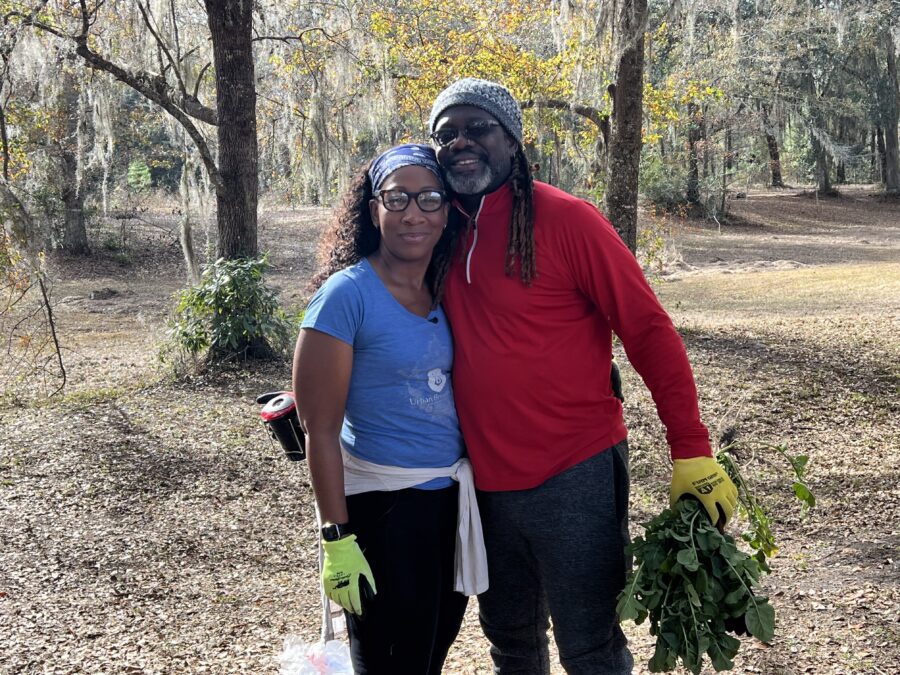
Matthew and Tia Raiford at Gilliard Farms near Brunswick, Georgia. Matthew, who co-owns the farm with his sister Althea, is the sixth generation in the family to farm the land. (Courtesy of Gilliard Farms)
Matthew and Tia Raiford at Gilliard Farms near Brunswick, Georgia. Matthew, who co-owns the farm with his sister Althea, is the sixth generation in the family to farm the land. (Courtesy of Gilliard Farms)
When Matthew Raiford, who co-owns Gilliard farms with his sister Althea, walks the property, history reveals itself with every step. “Everywhere you walk,” he says, “a family member or someone else connected with the land has told you what once happened there.” He talks about the old sugarcane press, the 1907 schoolhouse marked by a donated historical plaque and the faint traces of where the Southern Railroad once crossed the fields. His mother, now 80, and a direct descendant of Jupiter Gilliard, still begins stories the same way her elders did—“I remember when Pop used to … ”—each phrase reawakening a lineage that lives on vividly.

A short walk from the farmhouse, a great oak spreads its limbs wide enough to shelter generations. The family calls it the Mother Oak. “My grandmother used to swing from that tree when she was a baby,” Matthew says. “When I was a kid, there were swings there too. My mom just put one back up—a real old-school tire swing.” The swings themselves are new, but the act of installing them there are as old as the farm. Each generation returns to the same tree, retying memory to its branches.
For the Raifords, who are of Gullah Geechee heritage, storytelling is as essential as cultivation. Along the Georgia coast, the Gullah Geechee people—descendants of Africans once enslaved on the Lowcountry’s rice and cotton plantations—have preserved a distinct language, cuisine and spiritual relationship with the land. In and around Brunswick, their traditions still shape daily life, blending African agrarian knowledge with coastal ecology. Gilliard Farms sits at the heart of this heritage, embodying the endurance of a culture that rooted freedom in the soil. “We’re a matriarchal family,” Matthew explains. Our conversations were our memory,” Matthew says. “Our stories were never just told—they were performed, shared with the same passion they were first given to us.”
His sister Althea now carries that role as the family’s “story matriarch,” sustaining the oral tradition that bound their enslaved ancestors together when reading and writing were forbidden. The spoken word, Matthew says, is its own harvest—each telling renewing what might otherwise be lost.

That devotion to continuity helped earn Gilliard Farms state recognition in 2012 as a Georgia Centennial Farm, an honorary designation for properties tended by the same family for at least a century. “It’s not a grant or funding award,” says Rose Mayo, a preservation specialist with the Georgia Department of Community Affairs. “It’s an honorary designation that honors farms continuously worked by the same families for 100 years or more.”
For families like the Raifords, Mayo says, the designation formalizes what they’ve practiced all along—turning memory into record. “As part of the application, each family writes the story of its farm, how their grandparents built it, how they survived blights and market crashes, how they adapted,” she says. “For many, it’s the first time they sit down to put that history on paper and those stories become part of Georgia’s living heritage.”

Both Matthew and Althea served in the U.S. military before returning to their ancestral land. Matthew later studied at the Culinary Institute of America and became a certified ecological horticulturalist, merging fine-dining skill with regenerative practice. He and his wife, Tia, who he met while working at the 2008 Olympic Games in Beijing, now lead Gilliard Farms’ operations—bridging ancestral knowledge and global experience to sustain their family’s 150-year legacy.
If Matthew embodies the farm’s memory, Tia Raiford embodies its renewal. “Everything starts with the soil,” she says. “It’s alive. It feeds us, and we have to feed it back.” Together they compost everything possible—even fish and shrimp scraps from nearby markets—to replenish the minerals coastal farming demands.
Today, the Raifords cultivate seasonal vegetables, fruit, and herbs, along with sugarcane, peanuts and heritage grains and have remained pesticide-free since 1874. They also raise chickens and bees, creating a closed-loop ecosystem that supports their kitchen, farm store and agritourism programs—all expressions of the same land-based wisdom that has sustained their family for generations.
“We’re giving back to Mother Nature what she gave us,” Matthew says. “People call it regenerative farming now, but our ancestors were doing it long before anyone called it that.” They offer wellness products made from what they grow on the farm based on those centuries-old practices.
Tia views that reciprocity as both ecological and spiritual healing. “The planet will survive,” she says. “It’s whether we want to be part of that survival. If we do, we have to live in balance with the soil, the air, the water—all of it.” Through her eyes, farming becomes a restorative act—honoring those who endured by ensuring the land endures with them.

For Mayo, that endurance across generations defines the Centennial Farms she helps steward. “You see it again and again,” she says. “Blights, market downturns, and even wartime shifts—families pivoted, adapted, and kept going. That flexibility is what keeps a farm alive for 100 years.” The state’s archive, she adds, has become “a quiet record of resilience.” Its files hold letters, maps, and handwritten narratives that safeguard not just buildings or acreage but the people who refused erasure.
As evening settles over Gilliard Farms, the air smells faintly of salt and turned earth. Matthew stands beneath the Mother Oak, watching the light fade through its branches. “They brought us here because we knew how to work the land,” he says softly. “That knowledge—it’s still here.” The wind stirs the cane and the swing creaks once, as if answering him.
On Gilliard Farms, history isn’t buried. It grows through story, through healing, through heritage. On its 50 acres of Georgia soil, the past is not something to look back on but something still alive beneath every footprint, carrying forward the memory of all who refused to be forgotten.

Dahna Chandler is an award-winning business and finance journalist with over 25 years of experience writing for media outlets and brands. She loves storytelling and organic food.
Have thoughts or reactions to this or any other piece that you’d like to share? Send us a note with the Letter to the Editor form.
Want to republish this story? Check out our guide.


More from Barn Raiser
Read →
Is Sludge Poisoning Your Well?
PFAS wreak havoc on rural Wisconsin drinking water. Rural wells nationwide could face similar issues.

Read →
Senate Faces Mounting Pressure to Restrict Voting Rights
Rural voters, conservative women hurt most by SAVE Act