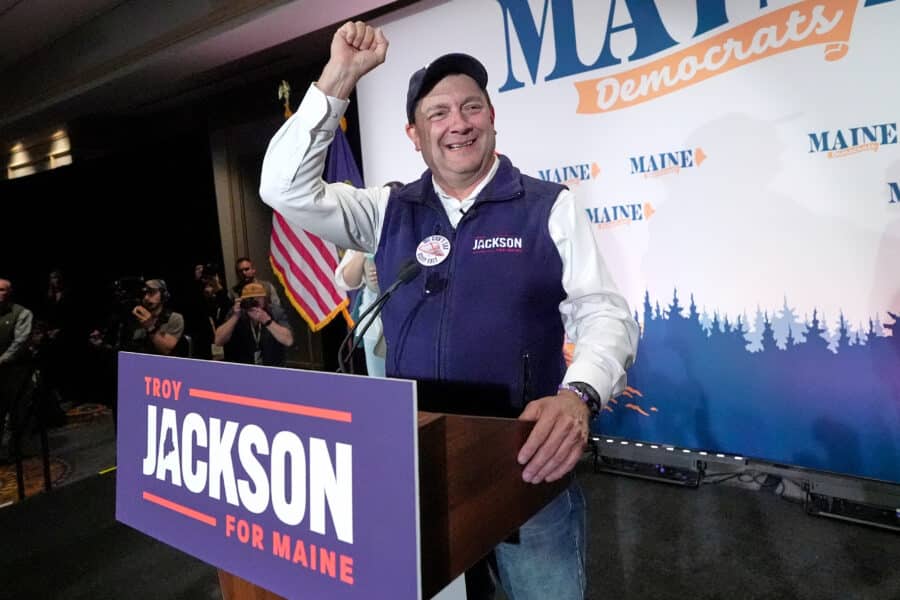
Maine Democratic Senator-elect Troy Jackson, a 5th generation logger from Aroostook County speaks on Election Night, Wednesday, in Portland, Maine. (Robert F. Bukaty, AP Photo)
Troy Jackson’s victory over 30-year Republican incumbent Sen. Susan Collins made national headlines. Troy was only nominated four months ago, after Graham Platner withdrew. Platner’s volunteer base and their enthusiasm for economic populism transferred to Jackson, but that does not diminish his victory over Collins.
Total spending likely exceeded $250 million in an election with less than 700,000 voters.
Maine Democratic Senator-elect Troy Jackson, a 5th generation logger from Aroostook County speaks on Election Night, Wednesday, in Portland, Maine. (Robert F. Bukaty, AP Photo)
While the majority of those funds supported Collins, Democratic donors and their Super PACs contributed over $100 million. Total expenditures of nearly $400 per voter likely surpassed every other election in the United States, and highlight the need for campaign spending reform.
Across the board, Democrats nearly swept Maine. Hannah Pingree was elected governor, and her mother, incumbent Chellie Pingree, was reelected in the 1st Congressional District. The 2nd Congressional District is currently a virtual tie between Democratic State Auditor Matt Dunlap and former governor Paul LePage. (As of Wednesday afternoon, LePage led with 50.3% of the vote with 94% of the votes counted.) Democrats have also retained a significant majority in the state legislature.
Sixty-five percent of Maine’s population is rural, second only to neighboring Vermont. Maine is an important part of a growing popular movement across rural America fueled by soaring health, energy and food costs, and a grassroots movement against data centers and artificial intelligence.
Maine’s story is also one of a working-class rebellion, led by the state labor federation and bolstered by Jackson’s amazing popularity among members of nearly every labor union in the state.
Jackson lives in Aroostook County in northern Maine, which straddles the border with Quebec and New Brunswick. He is a fifth-generation logger, and currently a member of three unions—Painters, Operating Engineers and Machinists. His 20 years in the state legislature included six years as Senate president, where he helped pass legislation that provided breakfast and lunch for all school children, expanded collective bargaining coverage to loggers, wood haulers and agricultural workers, protected abortion access and provided heating assistance for Maine families.
While detailed data is not yet available, Jackson’s vote totals in rural towns and counties far exceeded the last five Democratic challengers to Susan Collins, including in the two candidates’ home county, Aroostook, which Trump carried in 2024 by 26 points. Statewide, Jackson defeated Collins by about 7 points.
I met Jackson 20 years ago at a Maine AFL-CIO meeting, when I was President of the Communications Workers (CWA). Later, we worked together when he led the successful Maine primary campaign for Bernie Sanders in 2016, and again in 2020. His background, bio and manner will be unique in the U.S. Senate. He talks to everybody and loves it, regardless of their views or past voting behavior. In the last 100 days he held 100 public events, endearing himself across Maine.
But most importantly, Maine is about what Jackson can teach us. We can organize anywhere, rural or urban for Medicare for All. We can organize around workers’ rights and fighting the billionaires. We can organize for clean energy, both solar and wind, despite the fossil fuel companies. And we can build a majority coalition in rural counties for progressive change.
In Minnesota’s 1st Congressional District, The Irish Setters of Red Wing knocked on 4,000 doors to help elect high school math teacher Jake Johnson.
AAs the blue tsunami flooded the country on November 3, Jake Johnson, the Democratic candidate for Minnesota’s 1st Congressional District beat the Republican Brad Finstad, a Trump acolyte in a reliably red district, by 323 votes.
A recount is expected, but Johnson’s apparent victory has thrilled Democrats throughout Minnesota. How did Johnson, a high school math teacher and first-time candidate in this largely rural district, defeat Finstad, an incumbent who sits on the Agriculture Committee and won by 17 points in 2024?
One group of volunteers, the Irish Setters of Red Wing, contributed to Johnson’s success by consistent door knocking that gained steam over the course of the campaign. The group of 20 knocked on 3,500 doors between June and mid-October. And, in the last two weeks of October, they knocked on an additional 1,500 doors. “We could do that because by then we were all trained and we were better at it,” says Don Fricke, who co-leads the Irish Setters. The group also changed tactics. Instead of going out in groups three times a week, they switched to an “Adopt-a-Turf” model. “People would choose 3, 4, even 5 turfs and just keep working on those until they were finished,” Fricke says.
The Irish Setters knocked doors in Red Wing and throughout Goodhue County, and their hard work paid off. From 2024 to 2026, the vote for the U.S. House seat shifted blue by 7.5 points in Red Wing and by 6 points in Goodhue County as a whole. Although Johnson voters were the majority in only five of the district’s 21 counties, all of the counties underwent a blue shift.
It’s not always easy to knock on a stranger’s door and ask for their vote. But door knocking makes a difference, in election results and in people’s lives. As one recipient of the Irish Setters efforts posted online, “I hope you know that your visit helped me convince my MAGA dad to vote for Jake Johnson.”
Every door, every conversation and every vote counts.
Larry Cohen is a past president of the Communication Workers of America, was the founding board chair of Our Revolution and is a member of the Democartic National Committee, on which he has been working for 10 years on party reform.
Sherry Kempf, a writer and educator, lives in Minneapolis, where she is a member of the Bird Dogs. She also spends a lot of time in Red Wing and contributed to the launch of the Irish Setters.
Have thoughts or reactions to this or any other piece that you’d like to share? Send us a note with the Letter to the Editor form.